Influencer Marketing for Small Brands in India: Where to Start
A practical guide to influencer marketing for small brands in India, covering creator selection, budget planning, collaboration formats, campaign briefs, and how to measure results.
- Author
- Hasnain Ansari
- Published
- Reading time
- 13 min read
Influencer Marketing for Small Brands in India: Where to Start
When you're running a small business, getting people to notice your brand can be difficult. You might have a good product, a useful service, or a well-designed website, but reaching the right audience takes time.
Influencer marketing offers one way to bridge that gap. Instead of relying entirely on advertisements or your own social media following, you collaborate with creators who have already built an audience around a particular interest, lifestyle, or niche.
The good news is that you don't need a huge marketing budget or a celebrity partnership to get started. A small brand can begin with one relevant creator, a clearly defined goal, and a collaboration that makes sense for both sides.
Here's how to approach influencer marketing practically, especially if you're a small business or growing brand in India.
1. Understand What Influencer Marketing Can Do for Your Brand
Influencer marketing involves working with content creators to introduce your brand, products, or services to their audience. Depending on the collaboration, they might create a product demonstration, review, tutorial, short-form video, or sponsored post.
For a small brand, the main opportunity is reaching people who may not discover the business through its own channels.
For example:
A clothing brand could work with a fashion creator who regularly shares styling ideas.
A skincare business could collaborate with a creator who produces educational beauty content.
A local café could invite food creators to experience its menu.
A software startup could partner with creators who explain tools, productivity, or business workflows.
The important point is relevance. A creator with a smaller but interested audience may be a better fit than a much larger account whose followers have little connection to your product.
Influencer marketing can help with awareness, product discovery, engagement, and sales. However, results depend on the creator, the offer, the content, the audience, and what happens after someone sees the post. A collaboration does not guarantee sales.
2. Decide What You Want to Achieve First
Before searching for creators, decide what a successful campaign would look like.
Trying to increase awareness, gain followers, generate sales, and collect leads through one small campaign can make the results difficult to interpret.
Choose one primary objective.
Brand awareness
If people don't know your brand exists, focus on introducing it to a relevant audience. Track reach, impressions, video views, and relevant audience engagement.
Website traffic
If you want people to explore your products or services, use a dedicated landing page, campaign URL, or UTM-tagged link. Measure visits and meaningful actions on the website.
Sales and enquiries
If your priority is revenue, use a trackable offer code, unique link, enquiry form, or campaign-specific WhatsApp link where appropriate. Track completed purchases or qualified enquiries rather than likes alone.
Content creation
Sometimes a brand needs useful product videos or demonstrations that it can use on its own channels. In that case, you may want to commission content from a creator without necessarily paying for access to their audience. Agree separately on usage rights, paid-ad permissions, duration, and platforms.
A practical starting point: choose one objective for your first campaign and decide in advance how you'll measure it.
3. Find Creators Who Match Your Audience
Finding the right influencer is usually more valuable than finding the biggest one.
Start with the type of person who is most likely to buy from your business. Think about their interests, location where relevant, language, purchasing habits, and the problems your product solves.
Then look for creators whose content naturally connects with those interests.
Useful places to search include:
Instagram Reels and creator profiles
YouTube videos and Shorts
Relevant niche hashtags and community pages
Recommendations from customers, colleagues, and existing followers
Creator marketplaces and influencer discovery platforms
Search for content related to your category rather than relying only on broad terms such as “Indian influencer.”
For example, a home décor brand could explore creators who regularly share room makeovers, home organisation, or interior styling. A business software company might look for creators who discuss entrepreneurship, operations, or productivity.
Should you work with nano-, micro-, or macro-influencers?
Creator labels vary across platforms and agencies, so follower-count ranges are only rough guides.
Creator typePotential advantageWhat to considerNano creatorsOften have a focused community and may be accessible to smaller brandsAudience size and content quality can varyMicro creatorsCan offer a useful balance of niche relevance and reachCheck engagement quality and commercial ratesMacro creatorsCan provide broader exposureMay require a larger budget and more detailed campaign planning
Don't assume that a smaller creator always performs better. Review the audience, content quality, engagement patterns, and previous collaborations before deciding.
4. Check the Creator Before You Reach Out
A polished profile and a large follower count are not enough to establish whether a creator is right for your campaign.
Review their recent content rather than judging them by one viral post.
Look at:
Audience relevance: Do their followers appear interested in your category?
Content quality: Can they explain or demonstrate your product clearly?
Engagement quality: Do comments look relevant and genuine, or mostly repetitive?
Consistency: Do they publish regularly and maintain a recognisable style?
Previous partnerships: Are sponsored posts presented naturally and transparently?
Professionalism: Do they communicate clearly and follow agreed timelines?
Audience location: If you're selling primarily in India, is the audience in your target market?
Ask for a media kit or recent audience insights when appropriate. Depending on the campaign, useful information may include audience geography, age ranges, average views, story reach, and performance from previous sponsored content.
Be cautious about suspicious follower spikes, repetitive comments, inflated view counts, or creators who promise guaranteed sales.
No single metric proves that an audience is genuine. Use several signals together.
5. Set a Budget That Makes Sense for Your Business
There isn't one standard price for influencer marketing in India. Rates can differ significantly depending on the creator's audience, niche, platform, production effort, deliverables, exclusivity, and usage rights.
A small business should avoid spending its entire marketing budget on one collaboration simply because a creator is popular.
Instead, define the maximum amount you can afford to test without putting essential business expenses at risk.
Your campaign budget may include:
Creator fees
Product samples or gifting
Packaging and shipping
Content production requirements
Paid amplification or advertising permissions
Landing-page improvements and tracking
Taxes or platform-related charges, where applicable
Product gifting can be useful when a creator genuinely wants to try the product, but it should not be treated as a guaranteed substitute for payment. Agree on expectations before sending anything.
How much should a small brand spend?
Start by requesting quotes from several relevant creators. Compare what each quote includes rather than comparing prices alone.
One creator might offer a single Reel. Another might include a Reel, Stories, a link, and a defined period of content usage. These are different deliverables and should be evaluated accordingly.
For an initial test, consider working with one or a small number of creators. This makes it easier to understand what worked before committing to a larger campaign.
Avoid borrowing money or relying on optimistic sales projections to fund an untested collaboration.
6. Choose the Right Collaboration Format
Not every influencer campaign needs to be a traditional sponsored post.
The format should match the product, objective, and creator's normal style.
Product demonstration
Useful when customers need to see how something works, what it looks like, or how it fits into everyday life.
Review or experience-based content
The creator shares their genuine experience with the product or service. Avoid demanding a positive review; the content should reflect their actual experience.
Tutorial or educational content
Works well for products that solve a problem or require explanation. Examples include software walkthroughs, styling tips, and practical product guides.
Unboxing
Can introduce the product, packaging, and first impressions. It may be less useful when customers need detailed proof of performance.
Affiliate collaboration
The creator earns a commission on tracked sales. This can align incentives, but the commission structure, attribution rules, payment schedule, and return policy should be clear.
User-generated content (UGC)
A creator produces content for the brand's own channels. This differs from influencer distribution: the creator's audience does not automatically receive the content just because they made it.
Before choosing a format, ask one question: What does the audience need to see or understand before taking the next step?
7. Write a Clear Campaign Brief
A campaign brief helps prevent misunderstandings and saves time for both the brand and the creator.
It doesn't need to be a long document. Include the information the creator needs to produce accurate content.
Your brief should cover:
Brand overview: What your business does and who it serves.
Campaign goal: Awareness, traffic, leads, sales, or content production.
Target audience: The people you want to reach.
Product or service: What is being promoted and how it works.
Key information: Verified benefits, features, price, availability, and limitations.
Deliverables: Platform, number of posts, format, approximate duration, and publishing date.
Compensation: Fee, gifting, commission, or another agreed arrangement.
Tracking: Unique links, discount codes, or campaign landing pages.
Content usage: Whether the brand can repost, edit, or use the content in advertisements, and for how long.
Disclosure: Clear identification of the commercial relationship in line with applicable rules and platform policies.
Give creators room to communicate in their own voice. A script that forces every sentence can make the content feel unnatural and may undermine the trust that made the creator attractive in the first place.
At the same time, don't leave important product details, claims, or legal requirements open to interpretation.
8. Make It Easy for Interested People to Take Action
A campaign can generate attention and still fail to produce useful business results if the next step is confusing.
Before publishing, check where people will go after seeing the content.
For an online store, the link should lead to the relevant product or collection rather than a generic homepage. For a service business, it might lead to a focused service page, enquiry form, booking page, or WhatsApp conversation.
Make sure the destination works well on mobile devices. Many social media visitors will open it on a phone.
Check that:
The page loads reliably.
The product or service is explained clearly.
Pricing and next steps are easy to find.
Contact or checkout options work.
The page provides enough information to build confidence.
Analytics and campaign tracking are configured where appropriate.
If your website is slow, confusing, or missing important information, more influencer traffic may not solve the underlying problem.
9. Measure Results Beyond Likes
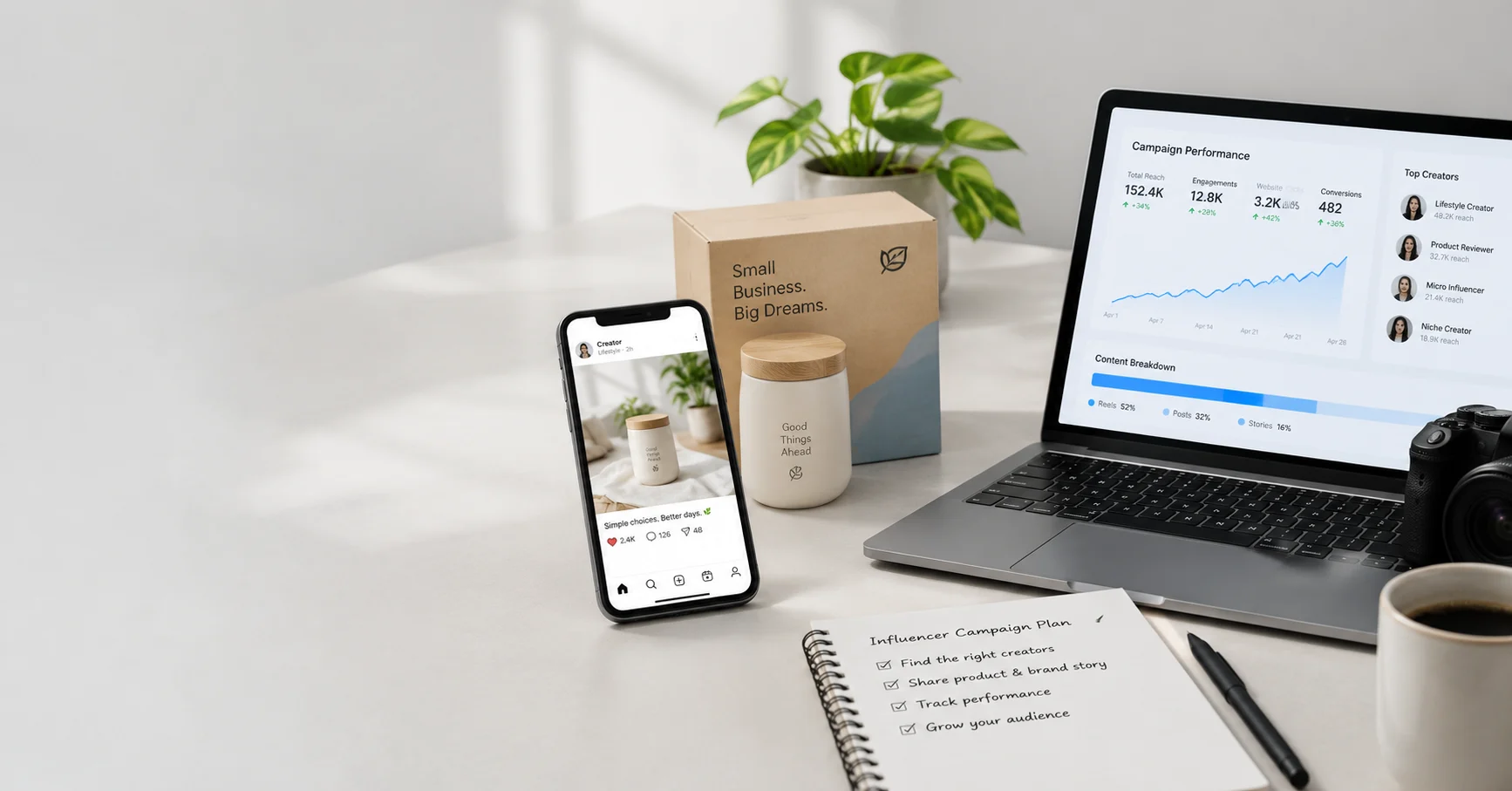
Likes and views can indicate attention, but they don't automatically show whether a campaign helped your business.
Choose metrics that match your original objective.
Campaign objectiveUseful metricsAwarenessReach, impressions, video views, audience relevanceEngagementRelevant comments, shares, saves, meaningful interactionsWebsite trafficLink clicks, sessions, landing-page engagementLeadsQualified enquiries, completed forms, bookingsSalesTracked orders, conversion rate, revenue, contribution after costsContent productionDeliverable quality, usability, usage rights, production cost
Use a unique tracking link, UTM parameters, or creator-specific discount code where appropriate. Keep in mind that no tracking method captures every purchase perfectly: people may see a post and buy later through another channel.
Calculate whether the campaign was worthwhile
For a sales campaign, compare the cost of the collaboration with the profit generated by attributable orders—not just total revenue.
For example, if a campaign costs ₹10,000 and generates ₹15,000 in sales, that does not automatically mean the campaign made a profit. You still need to account for product costs, shipping, discounts, payment fees, returns, and other relevant expenses.
For awareness campaigns, immediate sales may not be the right measure. The value might lie in reaching a relevant audience, generating useful content, or introducing the brand to future customers. Define that value before the campaign starts rather than inventing it afterward.
10. Follow India's Advertising Disclosure Rules
Sponsored content should be transparent. When a creator receives payment, free products, discounts, affiliate commission, or another material benefit, the relationship may need to be disclosed under applicable Indian guidance and platform rules.
The Advertising Standards Council of India (ASCI) publishes influencer advertising guidelines, including disclosure requirements for material connections between advertisers and influencers.
Common disclosure labels include “Ad,” “Sponsored,” and “Collaboration,” depending on the context and applicable guidance. The disclosure should be clear and easy to notice, not hidden among unrelated hashtags.
Brands and creators should also take care with claims about health, finance, beauty, performance, or other regulated or sensitive product categories. Claims should be accurate, substantiated, and consistent with applicable law.
Before launching a campaign, review the latest guidance from ASCI and the relevant social platform. This is especially important if your product category has additional advertising restrictions.
11. Common Mistakes Small Brands Should Avoid
Some problems can be prevented with a little planning.
Choosing creators only by follower count. A large audience isn't useful if it has little interest in the product.
Expecting guaranteed sales. Influencer marketing is not a promise of revenue. Treat the first campaign as a measured test.
Sending products without clear expectations. Confirm whether the creator has agreed to publish content, what they will deliver, and whether the arrangement is paid or gifted.
Micromanaging every word. Provide accurate information and clear boundaries, but allow the creator to communicate naturally.
Ignoring usage rights. Permission to publish a post doesn't necessarily include permission to reuse the content in paid advertisements or other channels.
Failing to track performance. Without a defined objective and tracking method, it becomes difficult to decide whether to repeat the collaboration.
Stopping after one campaign. One result may not tell the whole story. Review what happened, identify possible reasons, and decide whether a revised test is justified.
12. A Simple 30-Day Starting Plan
If you're new to influencer marketing, a short, structured test is often more useful than a complicated campaign.
Week 1: Prepare
Define your target customer and campaign objective.
Select the product or service you want to promote.
Set a budget limit.
Prepare a suitable landing page or destination.
Decide how you'll track results.
Week 2: Research and contact creators
Build a shortlist of relevant creators.
Review recent content and audience insights.
Contact suitable creators with a concise, personalised message.
Compare quotes, deliverables, timelines, and usage rights.
Confirm the arrangement in writing.
Week 3: Launch the collaboration
Provide the product information and campaign brief.
Confirm the content schedule and disclosure requirements.
Review factual claims and agreed brand details.
Publish the content and verify that links work.
Record initial campaign metrics.
Week 4: Review and learn
Compare the results with your original goal.
Review traffic, enquiries, sales, or content performance.
Calculate costs and commercial outcomes where measurable.
Ask what could be improved.
Decide whether to repeat, adjust, or stop the campaign.
This timeline is a practical example, not a guarantee that every creator or campaign can be completed in 30 days. Availability, product shipping, production time, and approval requirements can affect the schedule.
Frequently Asked Questions
Is influencer marketing suitable for small businesses in India?
It can be. Small businesses can work with niche creators, test specific products, and start with a limited campaign. Suitability depends on the audience, product, budget, and ability to measure useful results.
Do small brands need to work with influencers who have millions of followers?
No. A smaller creator may be a better match for a specific audience or budget. Evaluate relevance, content quality, audience insights, and the proposed deliverables instead of relying on follower count alone.
Is gifting enough to get an influencer collaboration?
Sometimes, if the creator voluntarily agrees to a gifting arrangement. It should never be assumed that receiving a product obligates someone to publish content. Agree on expectations before sending products.
Which platform should a small brand use?
Choose based on where your target customers spend time and what type of content helps them make a decision. Instagram may suit visual products and short-form demonstrations; YouTube can support deeper explanations and reviews. Other platforms may be more appropriate for particular audiences or industries.
How can I find influencers for my small business?
Search for creators in your product category, examine their recent content, assess audience relevance, and contact a shortlist with a clear proposal. Request recent performance data when it is relevant to your decision.
How do I know if an influencer campaign worked?
Measure the results against the goal you set before launch. Track reach for awareness, qualified enquiries for lead generation, and attributable orders and profit-related metrics for sales campaigns. Engagement alone does not establish commercial success.
Final Thoughts
Influencer marketing doesn't have to begin with a celebrity, a large agency, or an expensive campaign. It can start with understanding your customer, finding a creator whose content fits your brand, and agreeing on a small collaboration with a clear purpose.
Prepare the destination before driving traffic to it. Make expectations clear. Track what happens. Then use the results to decide what to do next.
The first campaign doesn't need to prove that influencer marketing will transform your business. It needs to give you enough reliable information to make a better next decision.
About the Author
Hasnain Ansari is an AI Creative Designer and Web Developer based in India, working across digital design, website development, and online experiences. Through his work, he explores how thoughtful design, useful content, and practical digital strategies can help businesses communicate more effectively online.
Explore more articles on web development, design, SEO, and digital workflows at hasnainansari.in.